Can You Whiten Veneers? Important Facts to Know
If you have veneers and your smile no longer looks as bright as it once did, the first question is usually simple: can they be whitened the same way natural teeth can?
The short answer is no, not in the usual sense.
That answer often catches people off guard. It is especially frustrating for anyone who invested in a cosmetic treatment expecting a long-lasting bright smile, only to notice a mismatch develop over time. I have seen this happen in a few very predictable scenarios. A patient gets porcelain veneers on the front teeth, years pass, coffee and tea habits stay the same, and then they try an over-the-counter whitening strip hoping everything will lift evenly. Instead, the natural teeth may respond a little, while the veneers stay exactly the same shade. The result is not brighter veneers. It is often a more obvious color difference.
That is the core fact to understand: veneers are not living tooth structure. They do not absorb bleach the way enamel does, and they do not lighten with conventional whitening products. But that does not mean you are stuck if your smile looks dull, darker, or uneven. The real answer is more nuanced, and it depends on what kind of veneers you have, why they look different, and whether the issue is the veneer itself or the surrounding teeth.
Why veneers do not whiten like natural teeth
Natural teeth contain enamel and dentin, both of which can be affected by whitening agents such as hydrogen peroxide or carbamide peroxide. These agents penetrate the tooth and break apart stain compounds. That is why professional whitening can brighten natural teeth by several shades, although results vary.
Veneers are different. Most are made from porcelain or composite resin. These materials are designed to mimic the look of enamel, but they do not behave like enamel under bleaching products. A porcelain veneer is a thin shell bonded to the front surface of the tooth. Its shade is chosen when it is made, and that shade remains stable unless the surface becomes stained, worn, or damaged. Composite veneers are a little more complex because they can pick up discoloration over time, but they still do not truly bleach the way natural teeth do.
This distinction matters because many people use the word “stained” to describe any darker look. In practice, there are several different problems that can make veneers seem less white:
The veneer surface may have accumulated external stain from coffee, tea, red wine, tobacco, or strongly pigmented foods.
The polish on a composite veneer may have worn down, making it easier for stain to cling.
The natural teeth next to the veneers may have darkened, which makes the veneers appear more yellow or less bright by comparison.
The bonding material near the edges may have discolored, especially with age.
The underlying tooth color may be showing through differently if the veneer is thin or the bond is aging.
None of those issues is solved in quite the same way. That is why a blanket answer like “just whiten them” usually leads nowhere.
Porcelain veneers versus composite veneers
The type of veneer changes your options.
Porcelain veneers are highly stain resistant. That does not mean stain proof. Surface buildup can still occur, especially if someone drinks a lot of coffee, uses tobacco, or has not had a recent professional cleaning. But in most cases, the porcelain itself has not changed color very much. What has changed is the surface appearance.
Composite veneers are more porous than porcelain. Over time they can absorb pigments, lose luster, and look duller. They still do not respond predictably to whitening gels, but they can often be polished, resurfaced, or replaced more easily than porcelain.
In a clinical setting, this difference shows up clearly. A porcelain veneer that looks “yellow” often brightens noticeably after a thorough cleaning and polish. A composite veneer that looks yellow may improve some with polishing, but if the discoloration is deeper in the material, replacement may be the only real cosmetic fix.
What whitening products actually do to veneers
People understandably want a simple product solution. Drugstore whitening strips, whitening toothpaste, LED kits, charcoal pastes, and whitening rinses all promise some version of a brighter smile. For natural enamel, some of these products can help. For veneers, the picture is much less impressive.
Whitening strips and gel trays generally do not lighten the veneer material. If your natural teeth around the veneers whiten, you may create a mismatch. That is one of the most common problems after unsupervised whitening.
Whitening toothpastes can remove surface stains from natural teeth and may also help clean the surface of veneers a bit, but they do not change the internal shade of the veneer. Some are also abrasive enough to be a bad idea, especially for composite veneers, because roughening the surface can make staining worse over time.
Charcoal products are a particularly poor bet. They are more hype than help, and repeated abrasion can damage the polished surface of restorations.
Professional whitening performed by a dentist is safer and more effective for natural teeth, but even then, the veneers themselves do not lighten. A dentist may still recommend whitening if the goal is to match the surrounding natural teeth to existing veneers, but that only works in specific situations.
When veneers look darker, the problem may not be the veneer
This is where good diagnosis matters more than any whitening product. A smile can look less bright for reasons that have very little to do with the veneer material itself.
A common example is plaque and calculus buildup. Even people with excellent brushing habits can accumulate deposits along the gumline and around the veneer margins. That buildup catches stain and makes the whole smile look older. A professional cleaning can make a bigger difference than patients expect.
Another example is dehydration and lighting. Teeth and veneers can look different under bathroom LEDs, office fluorescents, and natural daylight. I have seen people panic over a “yellow” veneer only to find that in natural daylight it matches beautifully. Shade perception is surprisingly sensitive.
Aging also changes the context around veneers. Natural enamel wears, gums can recede slightly, and neighboring teeth often darken with time. Veneers that looked perfectly harmonious ten years ago may now look off, even if the veneers themselves have not changed at all.
Then there is edge staining. The porcelain may still be fine, but the cement line or the tiny margin where veneer meets tooth can pick up color. In photographs, that can read as a darker or less clean smile. Depending on the cause, polishing may help, but sometimes the restoration is simply reaching the end of its ideal cosmetic lifespan.
What a dentist can do instead of “whitening” veneers
If you are unhappy with the color of your veneers, the best next step is usually an exam rather than a whitening purchase. Dentists have several ways to improve the appearance, but the right one depends on the material and the cause.
Here are the most common options:
- Professional cleaning and polishing to remove external stain and surface film.
- Whitening the natural teeth around the veneers to improve the overall color match.
- Recontouring or repolishing composite veneers if the issue is surface dullness or superficial staining.
- Replacing one or more veneers if the shade no longer works or the restoration has aged.
- Correcting other factors such as gum inflammation, edge leakage, or worn bonding material.
That list may look less exciting than a quick-fix whitening kit, but it is grounded in how these materials actually behave. Cosmetic dentistry works best when treatment matches the problem, not when everything gets treated as “stains.”
Can you polish veneers to make them look whiter?
Sometimes, yes.
Polishing is not whitening, but it can improve the look of veneers substantially if they have collected surface discoloration or lost some shine. This is particularly true for composite veneers, which tend to lose their luster faster than porcelain. A smoother surface reflects light better, and that alone can make teeth appear brighter.
For porcelain veneers, polishing may remove external residue and restore gloss if the surface is intact. However, if the porcelain glaze has been damaged or the veneer has microscopic scratches, only limited improvement is possible chairside. In some cases, a dentist can reglaze or refine the surface. In others, replacement is the better cosmetic choice.
One caution here matters. Home polishing is not the same as professional polishing. Using abrasive toothpaste, baking soda, or random polishing tools bought online can do more harm than good. Once the smooth finish on a restoration is scratched, stain tends to build faster.
If only your natural teeth are yellow, whitening may still help
This is one of the few times whitening makes sense in a veneer case.
Imagine someone has two porcelain veneers on the upper front teeth from years ago. At the time, those veneers matched the surrounding teeth perfectly. Ten years later, the veneers look relatively bright, but the neighboring natural teeth have darkened from age and daily habits. The person now feels the smile looks uneven and assumes the veneers turned yellow.
What often happened is the opposite. The veneers stayed stable while the natural teeth changed.
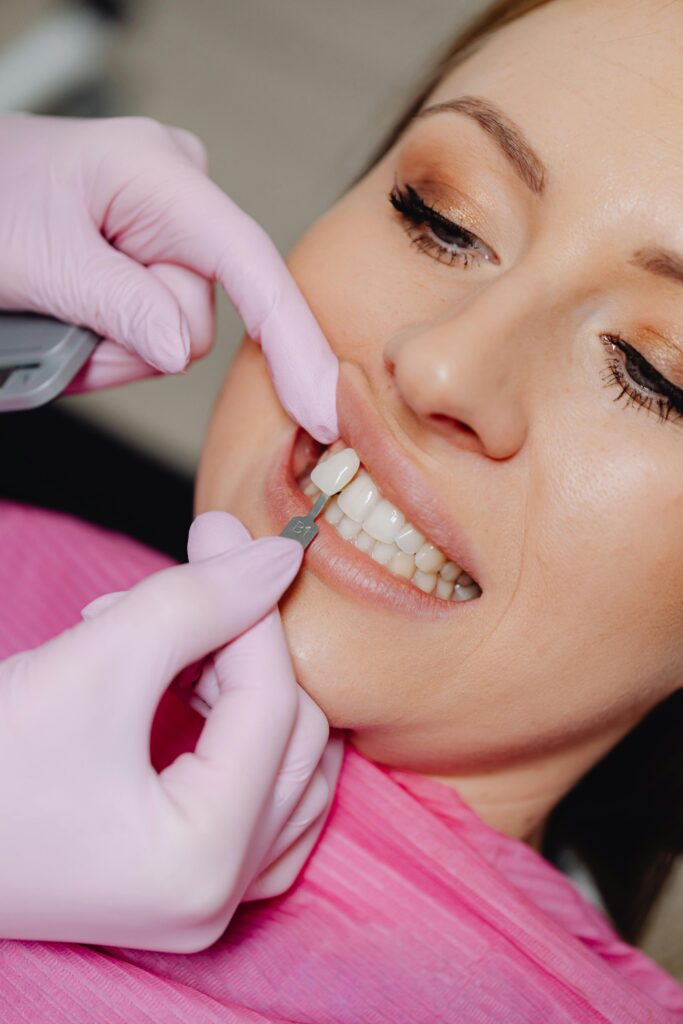
In that situation, whitening the natural teeth can restore harmony. The important detail is planning. A dentist will assess the existing shade of the veneers and estimate how closely the natural teeth can be brought back toward that color. Results are not guaranteed down to an exact shade match, but often the blend can be improved enough to avoid replacing restorations.
This is where store-bought whitening sometimes backfires. If the natural teeth become whiter than the veneers, the veneers may suddenly look darker than before. Controlled whitening with realistic shade goals is the safer approach.
When replacement is the only real solution
There are times when veneers cannot be cleaned, polished, or blended into a better match. Replacement becomes the practical answer, especially when the cosmetic issue is built into the restoration itself.
That might happen if the original veneer shade was chosen too dark, if your preferences changed and you now want a brighter smile, if the veneer has become chipped or worn, or if the margins are no longer aesthetically acceptable. Composite veneers also tend to need maintenance or replacement sooner than porcelain, though the timeline varies widely based on bite forces, habits, hygiene, and the original technique.
Porcelain veneers often last around 10 to 15 years, sometimes longer. Some fail earlier, some hold up beautifully beyond that range. Composite veneers generally have a shorter cosmetic lifespan, often closer to 4 to 8 years before noticeable maintenance or replacement is needed. Those are broad real-world ranges, not promises.
Replacement is not always a negative outcome. In many cases, it is a chance to update shade, shape, and symmetry. Dentistry has improved, materials have improved, and smile design tends to be more conservative and natural-looking now than it was in some earlier eras. If you are already facing replacement for functional reasons, adjusting the brightness at the same time is usually straightforward.
What to do before you commit to replacing veneers
Replacement is a bigger decision than whitening, so it deserves a thoughtful process. Shade alone should not drive everything.
A good evaluation looks at the smile as a whole. Does the color issue come from the veneers, the adjacent teeth, the gums, or the lighting in photos that is making the problem seem larger than it is in person? Are the veneers structurally sound? Do you grind your teeth? Has gum recession exposed natural tooth near the veneer margins? Is one tooth https://ameblo.jp/jaredycml957/entry-12977654166.html off, or are you reacting to the overall smile balance?
Patients sometimes arrive convinced that every veneer needs replacement, and after cleaning, whitening the adjacent teeth, and improving the polish on a couple of surfaces, the concern drops from urgent to minor. At other times, the opposite happens. What looked like a simple color issue turns out to involve margin leakage, fracture lines, and a poor original shade choice. Then replacement makes sense.
There is value in seeing cosmetic dentistry as a system rather than a single procedure. Color, surface texture, translucency, shape, gum frame, and lip line all affect whether teeth look bright and natural.
Daily habits that help veneers stay bright longer
You cannot bleach veneers, but you can reduce the chance of them looking dull or stained prematurely. Maintenance matters more than many people realize.
The most effective habits are simple:
- Brush with a non-abrasive toothpaste and a soft-bristled brush.
- Keep up with regular professional cleanings so surface stain does not build.
- Rinse or drink water after coffee, tea, red wine, or dark sauces.
- Avoid smoking or vaping with pigmented products, which can discolor margins and surrounding teeth.
- Wear a night guard if you grind, because surface wear and microdamage affect how restorations reflect light.
These steps will not make veneers whiter than their original shade, but they do help preserve the finish that makes them look clean, glossy, and bright.
A note on “no-prep” and ultra-thin veneers
Ultra-thin veneers deserve a brief mention because they can behave a little differently aesthetically. Since they are so thin, the underlying tooth color can influence the final result more than with thicker restorations. If the underlying tooth darkens, if the veneer was bonded over a strongly discolored tooth to begin with, or if the bond changes with time, the appearance may shift in a way that patients interpret as the veneer turning yellow.
Again, that does not mean the veneer can be whitened. It means the optical relationship between the veneer and the tooth underneath may be contributing to the problem. In those cases, replacement with a different opacity or shade may be necessary if the color is no longer acceptable.
Why online advice often causes confusion
A lot of cosmetic dental advice online mixes together natural teeth, bonding, crowns, and veneers as if they all respond the same way to whitening. They do not.
Crowns and veneers share some of the same limitations. Bonding and composite veneers can stain more than porcelain, but even then the fix is often polishing or replacement, not bleaching. Whitening strips can still affect the uncovered parts of teeth, which changes the overall appearance. That is why someone may swear a whitening kit “worked on their veneers” when what really changed was the natural enamel around them.
Another source of confusion is photography. Smartphone filters, ring lights, and image compression can exaggerate yellow tones or wash out detail entirely. Dentists usually evaluate shade under more controlled conditions for a reason. If you are making a decision about replacement, try not to rely only on selfies taken under mixed lighting.
The smartest next step if you are unhappy with veneer color
If your veneers look less white than you want, resist the urge to experiment first and diagnose later. It is easy to spend months cycling through whitening pastes, strips, and home hacks that either do nothing or create a bigger mismatch.
A focused dental visit is usually faster and cheaper in the long run. The question is not just “Can you whiten veneers?” It is “Why do they look darker, and what is the least invasive way to improve them?”
Sometimes the answer is a cleaning. Sometimes it is whitening the surrounding teeth. Sometimes it is polishing composite. Sometimes replacement is the honest answer. Good cosmetic dentistry is rarely about one universal trick. It is about identifying what changed and choosing the right correction with as little unnecessary treatment as possible.
Veneers can still be an excellent long-term cosmetic option. They simply follow different rules than natural teeth. Once you understand that, the next decision becomes much clearer.
Oaks Dental
Address: 5000 Parkway Calabasas Ste 308, Calabasas, CA 91302
Phone number: +18184312000
FAQ About Veneers
How much do veneers actually cost?
The cost of dental veneers typically ranges from $250 to $2,500 per tooth, with a full smile transformation averaging anywhere from $6,000 to $20,000 depending on the material you choose. Because veneers are classified as a elective cosmetic procedure, dental insurance almost never covers them.
What is the downside of having veneers?
The main downside of dental veneers is that the process is permanent and irreversible, as a dentist must shave off a thin layer of natural tooth enamel. Other major drawbacks include increased tooth sensitivity, high financial costs, and the need to replace them every 10 to 15 years.
What happens to the teeth under veneers?
When you get veneers, a dentist shaves off a thin layer of your natural tooth enamel (about 0.3 to 0.7 millimeters). The living tooth stays intact underneath, but losing this outer layer is permanent. The tooth relies on the veneer shell for lifelong protection and cannot be left bare.